
Automation Actions
Automations are built using a variety of actions that can be combined to create customized workflows tailored to your organization's needs. Automations are on the Standard, Professional, and Enterprise plans. Below is a list of available actions, along with descriptions and use cases for each.
No action changes a person's email, text, or call permission. To opt many people out at once, use the 'Opt Out of Communications' option in Bulk Update.
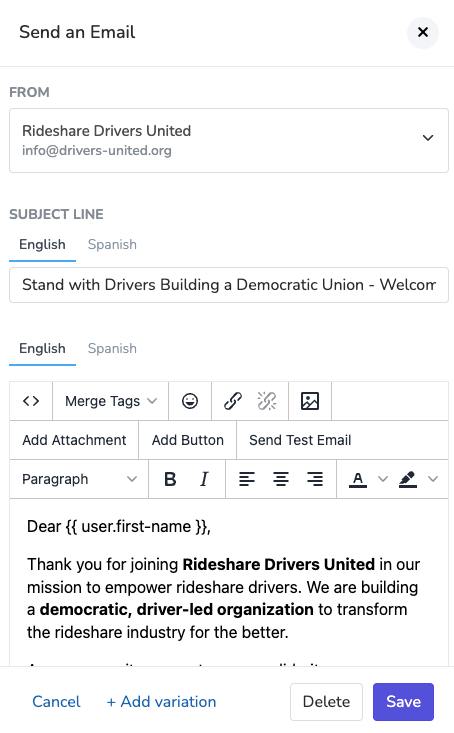
Send Email
Automatically send personalized emails to supporters at specific points in your automation workflow. Emails can be customized with templates and dynamic fields to ensure each message is relevant and engaging.
Use Case: After a supporter signs up on your website, you can send them a welcome email introducing your organization and suggesting next steps they can take to get involved.
Send Text
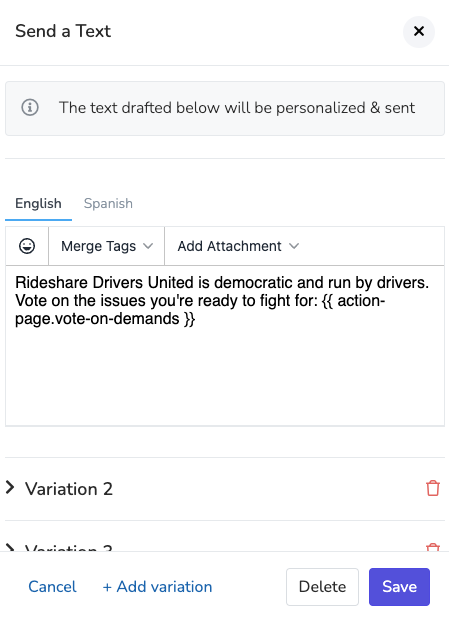
Send SMS messages directly to supporters' mobile phones. Text messages can be personalized with merge tags. To send a text later, put a Delay step before it.
Use Case: After a supporter RSVPs to an event, send them a text at once or after a Delay step. For reminders before each session, use the event's 'Automations' tab (see Event Automations).
Send Admin Notification Email
The 'Send admin notification email' action sends an email to the addresses in 'To', such as your team, not to the person.
Add Follow-Up Task
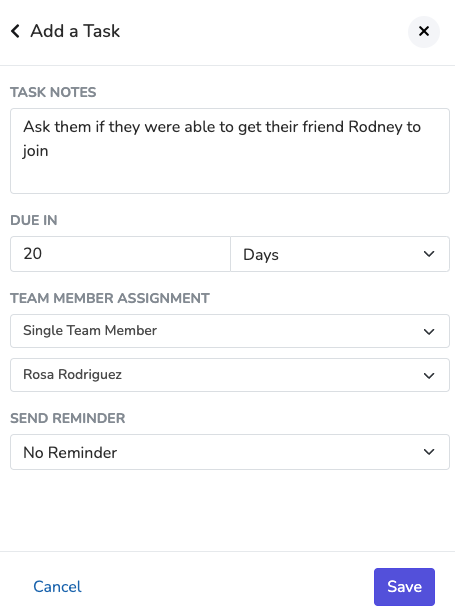
Create tasks for team members to follow up with supporters. Tasks help your team stay organized and ensure that important follow-up actions are not missed.
The step sets 'Task Notes', a 'Due In' time counted from when the step runs, and the 'Team Member Assignment'. It also has 'Send Reminder' and 'Send push notification on assignment'.
'Team Member Assignment' offers 'Single Team Member', 'Split Amongst Team Members', 'Existing Assigned Agent (if available)', and 'Branch Captain (if available)'. When your organization has team member groups, it also offers 'Split Amongst Team Member Group'. The team member pickers list only team members whose role has 'Can Be Assigned Agent'.
Use Case: After a supporter makes a significant donation, automatically create a task for a team member to call and personally thank them.
Assign Agent
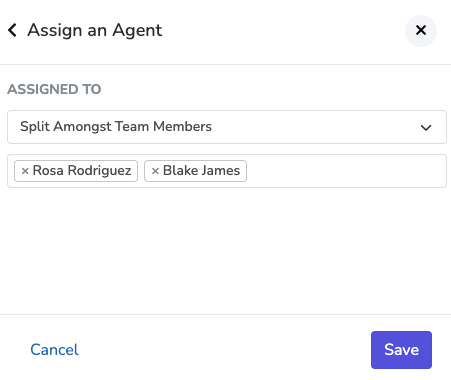
Assign a supporter to a specific agent or team member who will be responsible for managing the relationship. This helps personalize communication and ensures continuity.
The 'Assigned to' field always offers 'Single Team Member', 'Split Amongst Specified Team Members', and 'Branch Captain (if available)'. It can also show 'Split Amongst Team Member Group' and 'Form Completed By (Field Survey Agent)'.
- 'Single Team Member' assigns one team member that you pick. The team member's role must have 'Can Be Assigned Agent'.
- 'Branch Captain (if available)' assigns the captain of the person's branch within the scope of the automation. Branches are on the Professional plan.
- 'Split Amongst Specified Team Members' and 'Split Amongst Team Member Group' pick one team member at random from your list or group.
- 'Form Completed By (Field Survey Agent)' assigns the team member who completed the form.
Use Case: When a supporter expresses interest in volunteering, assign them to a volunteer coordinator who can guide them through the onboarding process.
Use Case (Branch Captain): When a new supporter joins from a specific region, automatically assign them to their local Branch Captain for personalized outreach and onboarding.
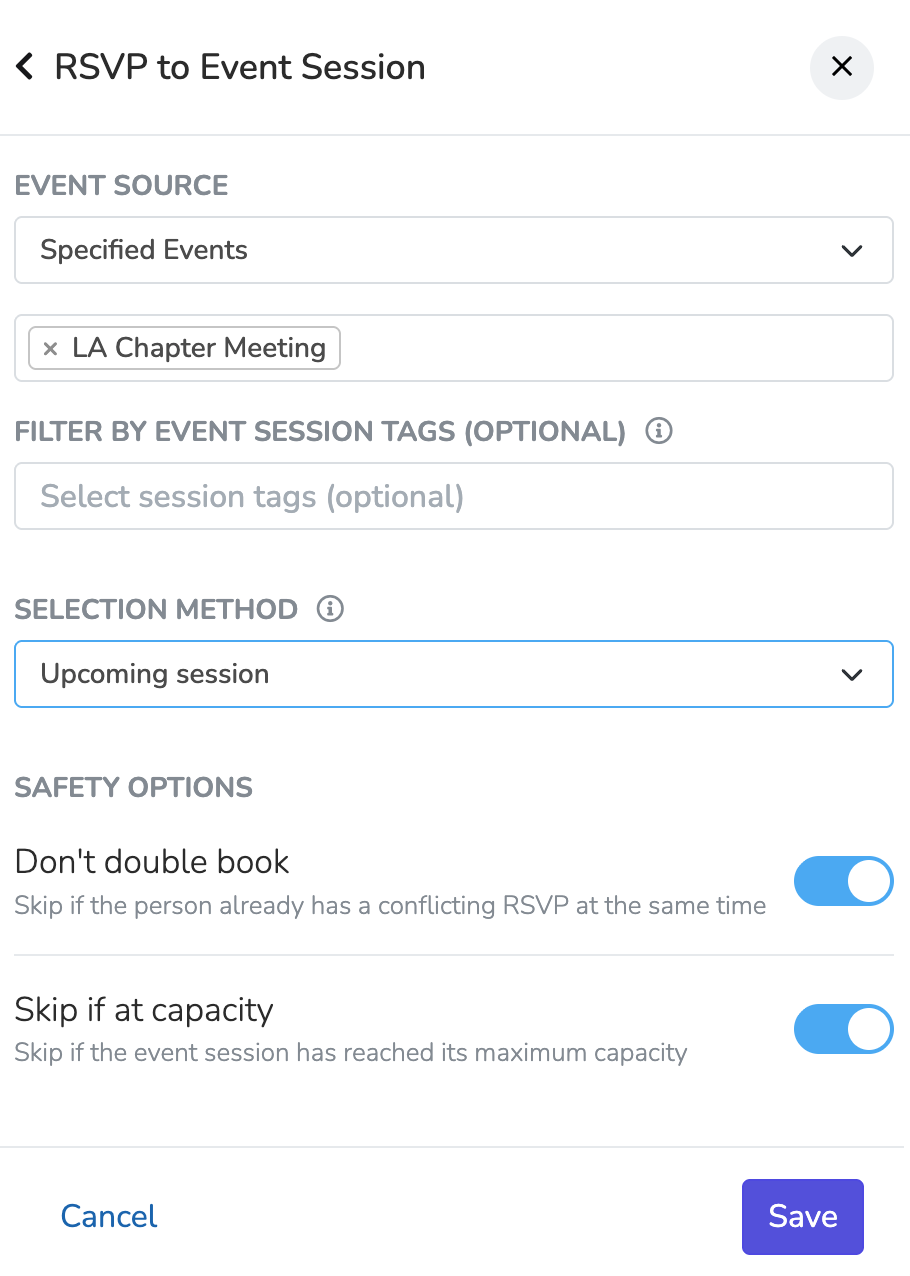
RSVP to Event
Automatically register supporters for events based on your selection criteria. This powerful action offers multiple assignment methods and safety features to ensure optimal event attendance while preventing conflicts.
The 'Selection Method' has five options. The default is 'Random selection'.
- 'Upcoming session' picks the earliest session that has not started yet.
- 'Random selection' picks one of the matching sessions at random. It does not balance people across sessions.
- 'Nearest location' picks the session closest to the person's address, or a random session when there is no address. For a recurring event at one place, use 'Upcoming session'.
- 'Fewest RSVPs' picks the session with the fewest Yes RSVPs. A tie goes to a random session.
- 'RSVP to all' RSVPs the person to every matching session that passes the 'Safety Options'.
Safety Options:
- 'Don't double book' is on by default. It skips a session that overlaps a Yes RSVP the person has for a session that has not started.
- 'Skip if at capacity' is on by default. It skips a session whose Yes RSVPs have reached its maximum capacity.
Use Case: When supporters complete a training program, automatically RSVP them to upcoming chapter meetings in their area using the "Nearest location" method, ensuring they stay engaged locally while preventing scheduling conflicts.
Update Tags
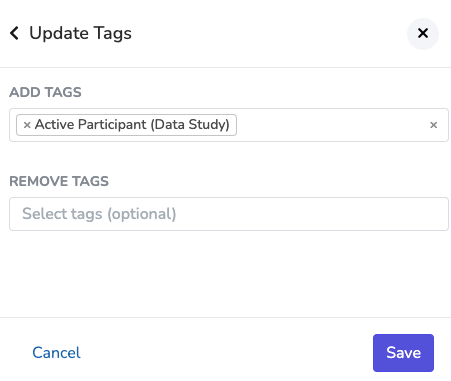
Add or remove tags from a supporter's profile to segment your audience and tailor your communications. Tags help you organize supporters based on their interests, actions, or status.
Use Case: Automatically tag supporters based on their level of engagement, such as "Active Volunteer" or "High-Priority Donor," to personalize follow-ups and future outreach efforts.
Update Custom Property
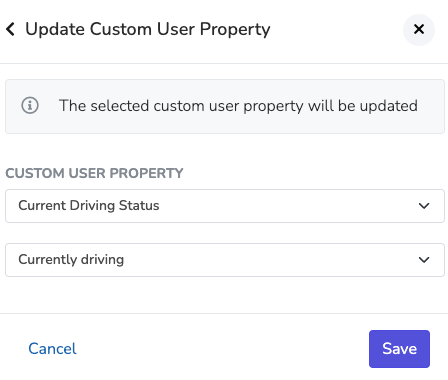
Update custom properties on a supporter's profile. Custom properties are fields you create to store specific information relevant to your organization.
For multi-select (checkboxes) properties, you can choose how the new values are applied:
The drawer has one checkbox, 'Add to existing values'. It is checked by default. Clear it to replace the current values with the selected values.
For all other property types (text, number, date, single-select, etc.), the action always sets the property to the specified value. The step saves the value exactly as you type it. It does not fill in merge tags or add to a number, but a date property can use 'Set to today's date (when automation runs)'.
Use Case: After a supporter completes a training program, update their "Training Completed" custom property to "Yes" so you can track their progress.
Use Case (multi-select): After a supporter attends a phonebank, add "Phonebanker" to their "Volunteer Skills" multi-select property without removing any other skills they've already been tagged with.
Update Chapter
The 'Update chapter' action makes a chapter that you pick the person's primary chapter, or adds it as a secondary chapter.
Update Assessment
Automatically update a supporter's assessment status. Assessments are organization-defined categories that help you track supporter engagement levels or stages in your organizing pipeline.
Use Case: When a supporter attends their first event, automatically update their assessment from "New Contact" to "Engaged" to reflect their increased involvement.
Use Case: After a supporter completes a volunteer training, update their assessment to "Trained Volunteer" so your team knows they're ready for assignments.
Webhook
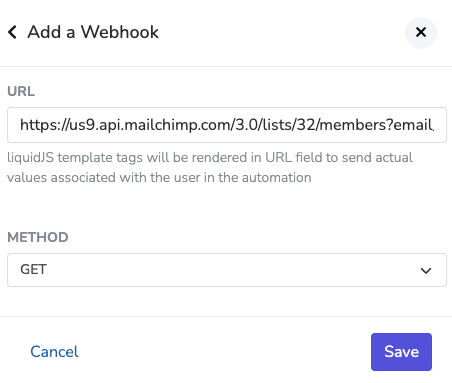
Trigger a webhook to send data to an external system. Webhooks allow you to integrate Solidarity Tech with other platforms and services, enabling seamless data flow and extended functionality.
Use Case: When a supporter signs up, send their information to a third-party CRM or email marketing platform for further engagement.
Passing Data in Webhooks
Merge tags work in three places: the URL, the values of custom headers, and the values of 'Body' fields. When the step runs, each merge tag becomes the person's data.
Basic Example
https://your-api.com/endpoint?email={{ user.email }}&name={{ user.first-name }}When executed for a supporter named "Jane Doe" with email "[email protected]", this becomes:
https://your-api.com/endpoint?email=jane%40example.com&name=Jane
Note: Special characters (spaces, @, etc.) are automatically URL-encoded for safe transmission.
Available Variables
User Variables
Use {{ user.variable-name }} to access supporter data:
| Variable | Description |
|---|---|
{{ user.id }} | Unique user ID |
{{ user.first-name }} | First name |
{{ user.last-name }} | Last name |
{{ user.full-name }} | Full name |
{{ user.email }} | Email address |
{{ user.phone-number }} | Phone number |
{{ user.address1 }} | Street address |
{{ user.address2 }} | Address line 2 |
{{ user.city }} | City |
{{ user.state }} | State |
{{ user.zip-code }} | ZIP/Postal code |
{{ user.country }} | Country |
{{ user.preferred-language }} | Preferred language |
{{ user.date-of-birth }} | Date of birth |
{{ user.referral-code }} | User's referral code |
{{ user.total-donated }} | Lifetime donation total |
{{ user.most-recent-donation }} | Most recent donation amount |
{{ user.date }} | Current date |
Custom User Properties: Any custom user property you've created is also available using its internal name with hyphens instead of underscores. For example, a property with internal name volunteer_status would be accessed as {{ user.volunteer-status }}.
Organization Variables
| Variable | Description |
|---|---|
{{ organization.name }} | Organization name |
Chapter Variables
| Variable | Description |
|---|---|
{{ chapter.id }} | Chapter ID |
{{ chapter.name }} | Chapter name |
{{ chapter.city }} | Chapter city |
{{ chapter.phone_number }} | Chapter phone number |
Webhook Examples
Sending to Zapier
https://hooks.zapier.com/hooks/catch/12345/abcdef/?email={{ user.email }}&first_name={{ user.first-name }}&last_name={{ user.last-name }}&phone={{ user.phone-number }}Sending to a Custom API
Put an API key in a custom header, not in the URL, because anyone who opens the step can see the URL.
https://api.yourservice.com/contacts/create?email={{ user.email }}&name={{ user.full-name }}&source=solidarity_tech&chapter={{ chapter.name }}Passing Custom Properties
If you have a custom property called member_type:
https://your-api.com/sync?email={{ user.email }}&member_type={{ user.member-type }}HTTP Methods
The 'Method' menu offers GET, POST, and PATCH. Select the appropriate method based on your external service's requirements.
Note: Custom headers go out with every method, and merge tags work in their values. With POST or PATCH, the 'Body' fields go out as one JSON object, and merge tags work in the body values. GET never sends a body.
Updated 4 days ago